
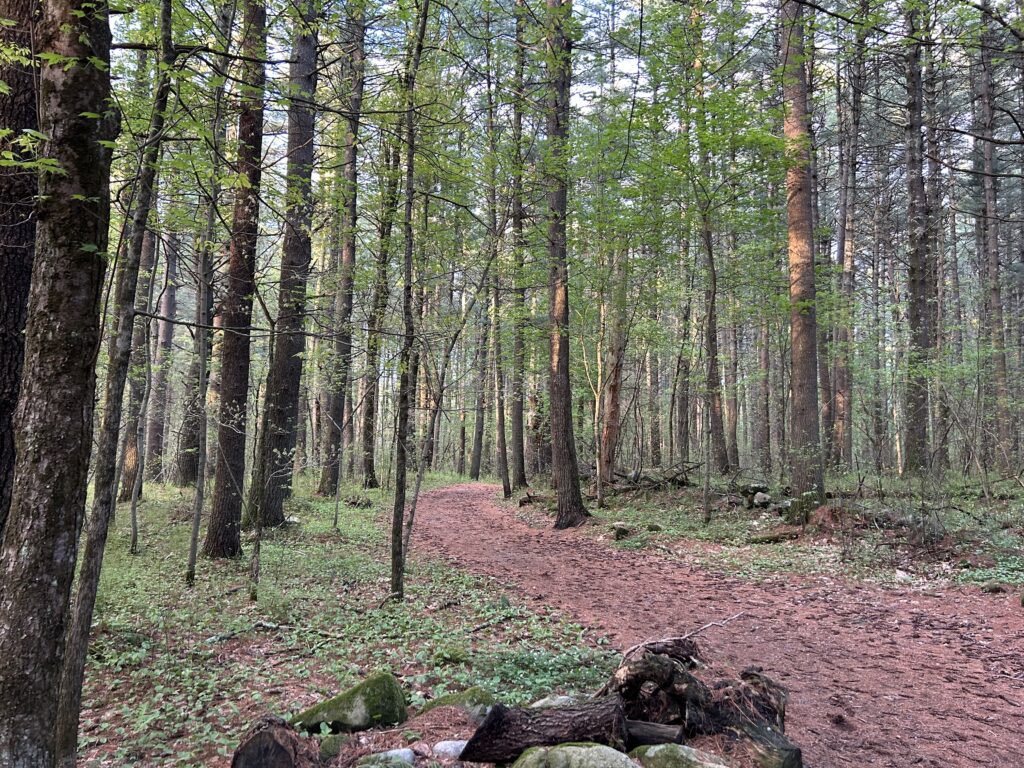
I strung up my three weight at an old farmstead an hour before sunset. A stone wall framed the still life of sagging wood structures and rusty equipment, all filtered through the green and gold glitter of a spring evening in the forest. It could have been the kind of place a Robert Frost character stopped to contemplate at dusk in a later season. New England is filled with thousands of places like this.
More walls still criss crossed my path deeper into the woods, marking boundaries that nature had nullified centuries ago. The brook trout, original inhabitants of this small valley creek, miraculously persisted through a centuries-long period of clear-cutting and heavy agriculture. If the studies were to be believed they were still here—entombed again under a reborn canopy, and ironically preserved by the land’s second act of development.
It seemed like a miracle anything was this well preserved out here, let alone clean enough to sustain native trout, this close to a major city. It was one of those ritzy suburban areas though—I’d learned many seasons ago that the green spaces with the best wild trout water and solitude usually had all the mansions. After all, it’s lonely at the top.
The creek moved in silence, a small amber ribbon sliding above sand and under deadfall. It made a brief appearance under a small footbridge, teasing its fishiness and allowing for only a few casts before slinking back into a thicket of blooming understory. There would be more hiking than fishing.
Exploring new water brings a level of sensitivity that often gets lost fishing the same-old. I am hyper-aware of every slight decrease of current, deeper trough, or undercut bank that could be worth a cast. Opportunistic trout can be anywhere, especially in unpressured small streams. I fished every accessible area of the creek like this, my optimism driving me through the next line of burberry and skunk cabbage.
Heightened senses also lend themselves to the rest of the forested experience. I was a nature camp kid, left for weeks at a time in younger summers to feed my fascination with wild places and the stories the land told. Alone out here, I could still ID a few songbirds by calls. Occasionally I’d spot what’s known as a “wolf tree”—generations older, perhaps by hundreds of years, than the forest around it, spared by clear-cutters and given room to spread its gnarled limbs wide in all directions. They were no longer my focus, these creatures, but they were part of the story. In a way, they were the reasons I came out here in the first place.
I followed a trail-topped earthen mound through the flooded forest. The last spot I’d fished was almost a mile away now—a small cascade that broke the wooded silence and formed the deepest hole I’d seen in the creek so far. When it didn’t produce, I passed on another round of bushwhacking and started for the road.
There’s an allure to the things we cannot have, one that I’ve found can sour quickly when fishing is involved. It’s amazing the grip that good or bad angling can have on a person’s mood, with the latter ruining a day or being declared a waste of time or money. The “it’s just nice to get out” band aid I’ve heard countless times at parking lots and during my fly shop days is almost always betrayed by disappointment in an angler’s eyes. When this happens at a brand new spot, there can be the added layer of a complete write off—“there’s nothing in this water. I’m never coming back here.”
It’s the non-refundable price we pay for exploring, for knowledge, and sometimes for just not being at our best. There are nuggets of peace one can take away from a skunking if you look for it—that welcome break between a stuffy office and quiet home life, or even just the ability to put in a few miles between the trees. And of course, the understanding that fisheries and all systems are in a constant state of flux. It’s hard to judge a spot by one or even a few slow days. The next time you set foot in that forest—for trout, meditation, whatever—it may not be the same.
The only other person I saw was a jogger that came off an adjacent trail and passed me as I packed up my car. He had an accent—Scottish I think, perhaps from a place where the fishing was better—and wanted to know what I was catching in the woods. “Nothing this time,” I said. “But it’s beautiful back there. Just nice to get out.”